
Why Is a Snack Vending Machine the Smartest Investment for Your Commercial Space?
Think about the last time an employee wanted a quick snack at work.
Maybe the pantry was empty. The canteen had already closed. The nearest shop was outside the premises. Or someone from Admin had to check the shelves, contact a supplier and arrange another refill.
Individually, these may seem like small inconveniences. Across hundreds of employees, multiple shifts and an entire year, they become an ongoing workplace-management challenge.
That is why businesses are beginning to look at refreshments differently.
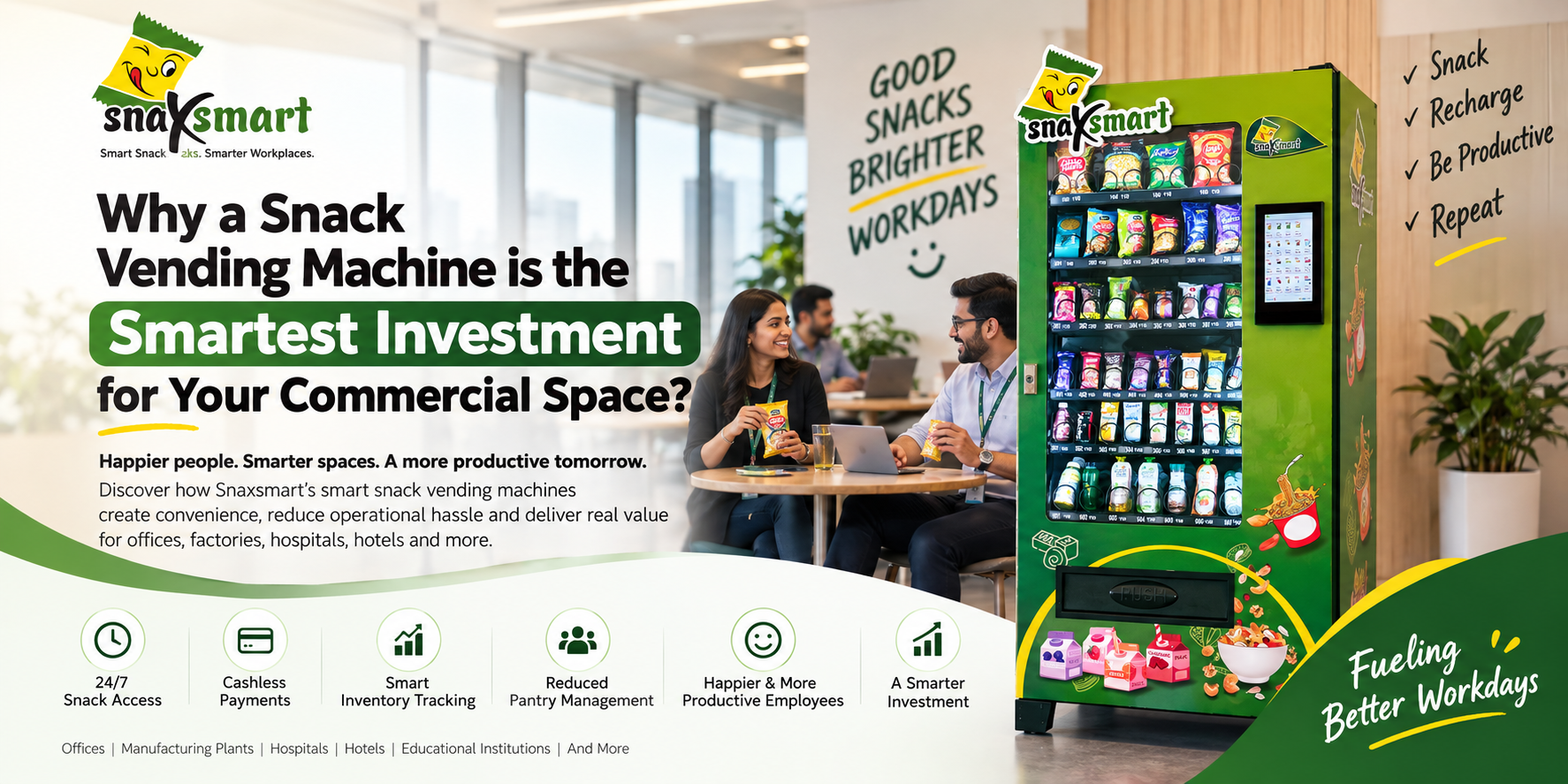
A snack vending machine is no longer simply a box that dispenses chips and drinks. Today’s smart vending machines combine self-service purchasing, cashless payments, IoT-enabled inventory monitoring and managed replenishment in one compact solution.
For corporate offices, manufacturing plants, hospitals, hotels and large commercial spaces, the investment is therefore not just in a machine.
It is an investment in convenience, automation and a simpler way to manage workplace snacking.
So, what makes a smart snack vending machine worth considering?
The Real Cost of Workplace Snacking Is More Than the Snacks
When businesses calculate the cost of their existing pantry or snack counter, they often look only at how much they spend buying products.
But snacks are only one part of the operation.
Someone may need to:
- Purchase and receive inventory
- Check what is running low
- Arrange refills
- Monitor expiry dates
- Maintain the pantry or counter
- Coordinate with vendors
- Handle employee requests
- Manage payments
- Track wastage
- Resolve availability issues
There may also be staff, storage, cleaning, electricity, equipment and maintenance costs.
A smart snack vending machine changes how many of these activities are managed.
Instead of creating another manual refreshment point, businesses can use an automated, self-service system with digital payments and connected inventory visibility.
That operational difference is where the business case starts.
1. One Machine Can Simplify Several Pantry Tasks
Consider a conventional office snack setup.
An Admin team notices that the snacks are running low. Someone checks what is missing, contacts the supplier, places an order, receives it and arranges the products.
A few days later, the process starts again.
With a managed office snack vending machine, much of the routine vending operation can move away from the company’s internal team.
Snaxsmart’s managed solution includes installation, inventory stocking, regular refills and timely replenishment.
For HR, Admin and Facility teams, that can mean less time spent asking:
“What is out of stock?”
“When is the next refill?”
“Who is managing the snacks today?”
The machine handles dispensing, while the managed vending model supports the ongoing operation.
Why does this matter financially?
Administrative time has a cost.
If employees spend several hours each month checking stock, coordinating suppliers and handling snack-related tasks, that is time the business is already paying for.
The value of automation is therefore not limited to the machine itself—it can also be measured in reduced operational involvement.
2. Employees Get Snacks When They Need Them, Not Just When the Pantry Is Open
A 9-to-5 refreshment model doesn’t fit every modern workplace.
Manufacturing plants may operate three shifts.
Hospitals operate around the clock.
Corporate employees may work late during deadlines.
Hotels have staff working early mornings, evenings and overnight.
A 24/7 snack vending machine can provide self-service access to packaged snacks and beverages outside normal pantry or canteen service hours, where site access permits.
This becomes particularly valuable in manufacturing environments. Snaxsmart positions smart vending as a complement to canteens, providing quick refreshments between meals and when regular food service is unavailable.
Think of a factory at 2 AM.
Production is still running.
The canteen may not be.
Employees should not necessarily have to leave the facility just to find a quick snack or beverage.
A strategically placed vending machine gives them another option without requiring the company to operate a staffed snack counter throughout the night.
That is a practical investment in workplace accessibility.
3. Cashless Vending Makes Every Purchase Faster
A workplace vending solution should make buying a snack easier, not create another queue.
Snaxsmart’s machines support cashless payment options including UPI, debit cards, credit cards and digital wallets.
The employee experience becomes simple:
Choose → Pay → Collect
There is no requirement for a dedicated cashier and less dependence on physical cash handling.
For a small workplace, that may simply mean convenience.
For a corporate campus or manufacturing facility with hundreds of potential daily users, self-service transactions become part of the operational advantage of a corporate vending machine.
4. Smart Inventory Tracking Replaces “Is Anything Left?”
A vending machine is useful only when people can find something they actually want to buy.
This is where an IoT-enabled vending machine becomes different from a basic snack dispenser.
Snaxsmart states that its machines support remote stock monitoring, while its manufacturing solution uses inventory and consumption visibility to support replenishment planning.
Instead of depending entirely on physical stock checks, the vending operation can get better visibility into:
- Product availability
- Fast-moving products
- Slow-moving products
- Consumption patterns
- Replenishment requirements
Imagine an office vending machine stocked with protein bars, nuts, baked snacks, biscuits and beverages.
After a few weeks, the data shows that protein bars and two beverage options consistently move faster.
That information can inform the next refill.
More of what employees choose. Less reliance on guesswork.
5. Better Inventory Decisions Can Help Control Waste
An overstocked pantry is not necessarily a well-managed pantry.
If products are purchased in quantities that do not match demand, slow-moving items can remain unused and may eventually expire.
The opposite problem is equally frustrating: popular products repeatedly running out.
Smart inventory monitoring provides information that can help balance the two.
Snaxsmart’s corporate vending offering uses automated usage information to help optimize restocking and understand popular product choices.
For businesses, this can support a more informed approach:
What sells quickly? → Stock appropriately
What moves slowly? → Review the quantity
What keeps running out? → Adjust replenishment
What do employees prefer? → Refine the product mix
The objective isn’t simply to fill every slot.
It is to stock the machine more intelligently.
6. A Small Footprint Can Deliver a Lot of Convenience
Commercial space is expensive.
Creating another staffed counter or refreshment area may involve furniture, storage, equipment and operational space.
Snaxsmart states that its standard machines can fit within approximately a 4 × 4 ft area, require a standard 15-amp power socket and do not require plumbing or major infrastructure.
That makes vending suitable for many existing spaces, including:
- Office break areas
- Factory rest zones
- Hospital staff areas
- Hotel common areas
- Employee cafeterias
- Reception areas
- Corporate campuses
- Educational institutions
The exact location should still be planned around employee movement, accessibility, power availability and expected demand.
But compared with building an entirely new refreshment counter, the infrastructure requirement can be relatively straightforward.
7. The Product Mix Doesn’t Have to Stay the Same
One common mistake in workplace snacking is assuming everyone wants the same thing.
They don’t.
A technology office may have one pattern of demand. A manufacturing plant may have another. Morning-shift employees may choose differently from night-shift workers.
A smart snack vending machine gives businesses the flexibility to adjust the product assortment based on workplace requirements and observed consumption.
Snaxsmart offers a range that includes healthier snacks, short eats and beverages, while product selection can be adapted based on workplace requirements and local availability.
This can help workplaces provide a mix that better reflects actual employee preferences instead of repeatedly purchasing the same products because “that’s what we always order.”
8. Smart Vending Can Reduce the Operational Load on HR and Facility Teams
The strongest business case for vending is often not a single dramatic saving.
It is the removal or reduction of many small recurring tasks.
Consider everything involved in manually managing workplace snacks:
Stock checking → Ordering → Receiving → Arranging → Monitoring → Reordering → Vendor follow-up
Now compare that with a managed vending workflow:
Monitor → Replenish → Maintain
Snaxsmart’s manufacturing solution specifically positions managed operations as a way to reduce day-to-day vending workload for HR, Admin and Facility teams.
That makes the value of vending broader than employee convenience.
It becomes an operational-efficiency decision.
9. What Does the ROI of a Snack Vending Machine Look Like?
This is where businesses should be careful.
There is no universal statement such as:
“Every vending machine saves X%.”
The financial impact depends on the workplace.
A company evaluating snack vending machine ROI should compare its current relevant costs with the proposed vending arrangement.
Current Snack/Pantry Costs
Consider:
- Pantry/snack procurement
- Staff involved in the snack operation
- Inventory management
- Food or snack wastage
- Cleaning
- Equipment maintenance
- Administrative time
- Vendor management
- Other applicable operating expenses
Smart Vending Costs
Then consider:
- Machine rental or purchase
- Applicable service charges
- Electricity
- Employer-funded snack subsidy, if any
- Other agreed operating costs
The basic comparison becomes:
Applicable Current Monthly Cost − New Vending Cost = Potential Monthly Saving
Then:
Potential Monthly Saving × 12 = Potential Annual Saving
This is much more useful than judging a vending investment only by the purchase price of the machine.
But there is one important distinction.
If vending replaces an existing staffed snack counter, more existing costs may potentially be avoided.
If vending partially replaces the pantry, only part of those costs should be included.
If vending simply complements an existing canteen, the financial calculation will be different because the canteen costs may remain.
That is why a proper vending ROI assessment should be based on the actual workplace setup rather than a generic savings percentage.
10. “Do We Have to Buy the Machine?”
Not necessarily.
Snaxsmart currently offers both snack vending machine rental and purchase options, with pricing depending on factors such as machine type, business model, location and product selection.
That gives businesses different ways to approach the investment.
A company that doesn’t want to make a larger equipment purchase can explore an appropriate rental or managed model.
A business with a different long-term requirement may evaluate purchase.
The right question is not simply:
“How much does a vending machine cost?”
It is:
“Which vending model makes sense for our workforce, usage and budget?”
11. What About Restocking and Maintenance?
This is another important concern.
A smart vending machine should reduce operational work—not give the Facility team another machine to constantly manage.
Snaxsmart’s managed offering includes inventory stocking, regular refills and replenishment, while its site also describes ongoing maintenance and support.
Before selecting any vending machine for a commercial space, businesses should confirm:
- Who monitors inventory?
- Who handles refilling?
- How frequently is stock replenished?
- Who handles machine issues?
- Is maintenance included?
- How quickly is service provided?
- Who monitors product expiry?
- What happens when demand increases?
The answers matter just as much as the hardware.
12. One Vending Solution Can Scale Across a Growing Workplace
Imagine a company starts with 250 employees in one building.
A year later, it has 600 employees across two floors.
Then it adds a second facility.
A traditional pantry setup may require additional infrastructure and management as the workplace grows.
Vending provides another scaling model: machines can be considered at different points based on employee strength, facility layout, shifts, expected transactions and walking distance.
Snaxsmart’s manufacturing offering supports multiple-machine planning for larger facilities.
For growing companies and multi-location businesses, this makes smart vending worth considering as part of a broader workplace-services strategy.
Where Does a Snack Vending Machine Make the Most Sense?
Corporate Offices : An office snack vending machine can provide employees with convenient refreshments while reducing some of the routine effort involved in managing snacks manually.
Manufacturing Plants & Warehouses : Vending is particularly useful for multiple shifts, large facilities and employees who may need refreshments outside regular canteen hours.
Hospitals : Doctors, nurses, support staff, attendants and visitors operate on very different schedules. Self-service vending can extend snack availability beyond conventional food-service windows.
Hotels : Vending can provide an additional self-service option for employees or suitable guest areas without requiring a staffed snack counter.
Corporate & Educational Campuses : Larger campuses can place vending points strategically based on footfall, building layout and user demand.
Is a Snack Vending Machine Right for Your Commercial Space?
Before investing, ask these seven questions.
1. How many people use the facility every day?
A building with 80 employees has different requirements from a campus with 2,000.
2. When do they need refreshments?
Look beyond standard office hours. Consider early mornings, evenings, night shifts and weekends.
3. What is your current pantry or snack operation costing?
Include more than products. Consider manpower, maintenance, wastage and administration.
4. Would vending replace or complement your existing setup?
This is essential for calculating realistic savings.
5. What products will people actually buy?
Product selection should reflect the workforce rather than assumptions.
6. Where should the machine be placed?
High accessibility and sensible employee movement are more important than simply finding an empty corner.
7. Who will manage the machine after installation?
A managed service can be significantly different from purchasing equipment and managing everything internally.
If your workplace has regular snack demand, extended operating hours, recurring pantry-management work or multiple employee shifts, a smart vending machine is worth evaluating.
The Smartest Investment Isn’t Always the Biggest One
Businesses often associate workplace investment with major projects: new office infrastructure, automation platforms, employee-benefit programmes or large facility upgrades.
But sometimes a relatively compact change can solve a very visible everyday problem.
A snack vending machine can make refreshments easier to access while introducing automation into an area that is often still managed manually.
For employees, that means convenient access to snacks and beverages.
For HR and Admin teams, it can mean fewer routine snack-management tasks.
For Facility teams, IoT-enabled monitoring can provide better inventory visibility.
For businesses, it creates an opportunity to evaluate whether workplace snacking can be managed more efficiently.
Snaxsmart combines IoT-enabled smart vending machines, cashless payments, inventory monitoring, managed replenishment and ongoing support for offices, manufacturing facilities, hospitals, hotels and other commercial environments.
The question is therefore not simply whether your commercial space needs a vending machine.
It is whether your current refreshment setup can be simpler, smarter and better aligned with the way your people actually work.
Ready to Find Out What Would Work for Your Workplace?
Share your employee strength, location and workplace requirements with Snaxsmart to explore a suitable vending setup.
Frequently Asked Questions
What is a smart snack vending machine?
A smart snack vending machine is a self-service vending solution that combines automated product dispensing with digital payment and connected capabilities such as inventory monitoring. Snaxsmart’s machines are IoT-enabled and support remote stock monitoring.
Is a snack vending machine a good investment for an office?
It can be a practical investment when a business has regular employee snack demand, needs access beyond pantry operating hours, wants to reduce certain manual snack-management activities or prefers a managed vending model. The financial case should be evaluated using the company’s actual costs and expected usage.
How much space does a snack vending machine need?
Snaxsmart states that its standard machines require approximately a 4 × 4 ft area, a basic 15-amp power socket and no plumbing or major infrastructure. Exact requirements should be confirmed for the selected machine and installation site.
Can a snack vending machine be rented instead of purchased?
Yes. Snaxsmart offers both rental and purchase options. The applicable cost depends on machine type, business model, product selection and location.
How are Snaxsmart vending machines restocked?
Snaxsmart provides a managed solution that includes inventory stocking, regular refills and timely replenishment. Its IoT-enabled machines also support remote stock monitoring.
Do smart vending machines support cashless payments?
Yes. Snaxsmart supports payment options including UPI, debit cards, credit cards and digital wallets, enabling self-service cashless purchases.
Can vending replace an office pantry or canteen?
It depends on the workplace. In some settings vending may replace or reduce a snack-counter operation. In others—particularly manufacturing facilities—it can complement an existing canteen by providing snacks between meals or outside normal service hours.
