


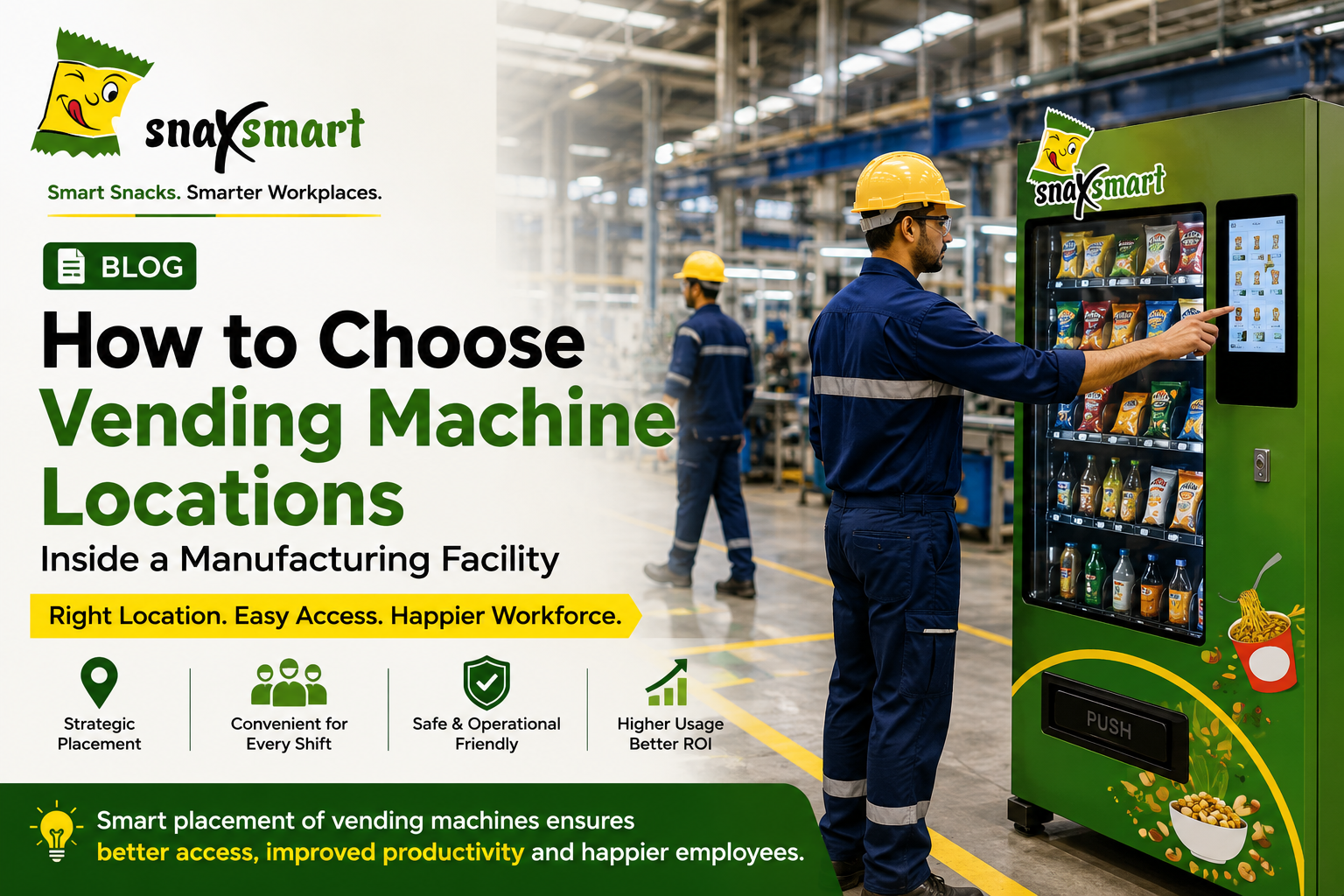
How to Choose Vending Machine Locations Inside a Manufacturing Facility
Installing a vending machine in a manufacturing facility is not simply about finding an empty corner and placing the machine there.
Location can directly influence how accessible and useful the vending machine is for employees.
Manufacturing plants often operate differently from regular offices. Employees may work across multiple shifts, production teams may have fixed or staggered break schedules, and some employees may have only a limited amount of time to access refreshments.
A well-planned vending machine location can make snacks and beverages easier to access while fitting smoothly into the facility’s existing workflow.
So, where should you install a vending machine inside a manufacturing plant?
Here are the key factors Facility, Admin, HR and Plant teams should consider.
Why Vending Machine Placement Matters in a Manufacturing Plant
A vending machine may offer convenient access to snacks, but employees will use it effectively only when it is placed in the right location.
If the machine is too far from work areas, difficult to access during breaks, or located in an inconvenient part of the facility, employees may not get the full benefit of it.
The objective should be simple:
Place the vending machine where employees can access it conveniently without disrupting normal plant operations.
The right location can help provide:
- Easier snack and beverage access during breaks
- Better accessibility across different shifts
- Reduced need to leave the facility for refreshments
- Convenient access when the canteen or cafeteria is unavailable
- Better utilisation of the vending machine
- A more convenient employee break experience
For facilities operating morning, evening and night shifts, placement becomes even more important.
1. Start With Employee Movement, Not Available Space
One of the most common mistakes is choosing a vending machine location simply because there is unused space.
Instead, begin by understanding how employees move through the facility. Ask questions such as:
- Where do employees normally spend their breaks?
- Which areas receive regular employee movement?
- How far are production areas from existing refreshment facilities?
- Do different shifts use different break areas?
- Which locations are easily accessible without entering restricted areas?
A location that employees naturally pass through is usually more practical than an isolated area that requires a long walk. The goal is not necessarily to find the busiest location. It is to find a convenient, accessible and operationally suitable location.
2. Consider Employee Break Areas
Employee break rooms and designated refreshment areas are often strong locations for a vending machine in a manufacturing plant.
Employees are already expected to visit these spaces during scheduled breaks, which makes access convenient without changing their normal movement around the facility.
A break-area vending setup can also complement existing facilities such as:
- Seating areas
- Drinking water stations
- Tea and coffee points
- Cafeterias
- Employee recreation areas
However, available space, electrical access, ventilation and employee traffic should still be evaluated before installation.
3. Think About Multiple Shifts
Manufacturing facilities often operate beyond standard business hours.
A plant may have employees working across first, second and third shifts, while cafeteria or canteen services may operate only during specific hours.
This creates an important question:
Can every shift access refreshments conveniently?
A smart snack vending machine can provide access beyond fixed cafeteria timings, but only if it is positioned somewhere that employees across shifts can reach.
When evaluating a location, consider:
- Shift timings
- Break schedules
- Night-shift accessibility
- Security restrictions
- Access to common areas
- Distance from major production zones
For larger plants, a single vending machine may not always be enough. Employee distribution and walking distance should help determine whether multiple machines or vending points are more appropriate.
4. Keep Walking Distance Practical
Break time in a manufacturing environment can be limited. If employees spend a significant part of their break walking to and from a vending machine, the location may not be practical. For example, a large manufacturing facility could have production lines, warehouses, assembly areas and administrative buildings spread across a wide campus. Instead of automatically placing one machine near the main entrance, Facility teams should evaluate where the actual workforce is concentrated. A useful approach is to map:
Work area → employee route → break area → vending point
This provides a clearer picture of where a machine can offer genuine convenience.
5. Avoid Locations That Interfere With Operations
Accessibility is important, but vending machines should not interfere with manufacturing activities.
Avoid placing machines where employee queues or movement could affect:
- Production lines
- Material movement
- Loading and unloading areas
- Emergency exits
- Safety equipment
- Forklift routes
- Narrow corridors
- Restricted production zones
The vending point should provide enough room for employees to select products and complete payments without obstructing normal movement.
Plant safety and facility guidelines should always take priority when finalising the location.
6. Check Power and Installation Requirements
Before confirming a location, make sure the space meets the technical requirements of the vending machine.
Depending on the machine and configuration, considerations may include:
- Suitable electrical connection
- Stable power availability
- Adequate floor space
- Level flooring
- Ventilation
- Safe clearance around the machine
- Network or connectivity requirements
- Easy access for servicing and refilling
These requirements should be reviewed during the site assessment rather than after the machine has been delivered.
A technically suitable location can make installation and ongoing operation much smoother.
7. Plan for Easy Refilling and Maintenance
Employees are not the only people who need convenient access to the vending machine. The team responsible for stocking, refilling and servicing the vending machine also needs to reach it efficiently. Imagine placing a machine deep inside a restricted production area. Every refill could require additional approvals, escorts or movement through operational zones. That can make routine servicing unnecessarily complicated. A better vending location should balance two requirements:
Convenient for employees + practical for servicing.
Easy service access helps simplify regular replenishment and machine support.
8. Consider Canteen and Cafeteria Timings
A vending machine does not necessarily need to replace an existing canteen.
In many manufacturing facilities, the two can work together.
A cafeteria may serve scheduled meals, while vending machines can provide convenient access to packaged snacks and refreshments between meal periods or outside regular canteen timings.
For example:
|
Workplace Situation |
How Vending Can Help |
|
Canteen closed during late shifts |
Provides access to snacks and refreshments |
|
Short employee breaks |
Offers a quick self-service option |
|
Staggered break schedules |
Allows employees to access products at different times |
|
Production area far from cafeteria |
Creates a closer refreshment point |
|
Extended operating hours |
Supports access beyond fixed service timings |
This is why understanding existing food-service infrastructure is important before deciding where the machine should go.
9. Look at Workforce Distribution
A plant with 500 employees does not necessarily have 500 employees working in the same area.
They may be distributed across:
- Production
- Assembly
- Quality
- Packaging
- Warehouse
- Dispatch
- Maintenance
- Administration
Instead of considering only total employee strength, look at where employees are actually located throughout the day.
For larger facilities, this may reveal the need for multiple vending points.
For example, one machine could serve a central employee break area while another supports employees working near a warehouse or a separate production block.
The final setup should be based on actual workforce movement and usage requirements.
10. Choose a Location Employees Feel Comfortable Using
A vending machine should be easy to notice and comfortable to use.
Avoid areas that are poorly lit, isolated or difficult to reach.
Where possible, choose a location with:
- Good visibility
- Adequate lighting
- Comfortable standing space
- Easy access during permitted break periods
- Clear approach and exit paths
Employees should be able to browse products, make a cashless payment and collect their purchase without feeling rushed or blocking others.
How Smart Vending Can Help Manufacturing Facilities
Location is only one part of an effective workplace vending setup.
Modern smart vending machines can also help businesses manage vending operations more efficiently.
Depending on the solution, smart vending can support features such as:
- Cashless and digital payments
- Remote machine monitoring
- Inventory visibility
- Product-level sales information
- Stock monitoring
- Managed replenishment
- Machine support
For manufacturing facilities with multiple shifts or large employee populations, these capabilities can make workplace vending easier to manage than a purely manual setup.
A Quick Vending Machine Location Checklist
Before approving a location inside your manufacturing facility, ask:
- Is the vending machine easily accessible to employees?
- Can employees reach it comfortably during their breaks?
- Is it accessible across relevant shifts?
- Is the location away from production and material-movement risks?
- Is adequate electrical infrastructure available?
- Is there enough space around the machine?
- Can the machine be refilled and serviced easily?
- Does the location complement existing cafeteria or canteen facilities?
- Is the area visible and well lit?
- Does the location serve a meaningful concentration of employees?
If several answers are “no,” it may be worth evaluating another location before installation.
One Plant May Need More Than One Vending Point
There is no universal rule that every manufacturing facility should have one vending machine.
A smaller facility may be served effectively by one strategically positioned machine.
A large plant with multiple production blocks, warehouses or employee break areas may benefit from several vending points.
The decision should consider factors such as:
employee strength + facility layout + shift patterns + break schedules + walking distance + expected usage.
This creates a vending setup based on how the facility actually operates rather than simply placing machines wherever space is available.
Plan the Right Vending Setup for Your Manufacturing Facility
Choosing the right vending machine location requires an understanding of both employee convenience and plant operations.
Snaxsmart provides smart snack vending solutions for manufacturing plants, factories, warehouses and other workplaces. The vending setup can be planned based on your workforce, facility layout, operating shifts and usage requirements.
With cashless payments, smart monitoring, managed stocking, regular refilling and machine support, businesses can provide convenient snack access without adding another routine vending-management task to their internal teams.
Planning a vending machine for your manufacturing facility?
Request a Site Assessment or Talk to Snaxsmart About Your Plant Vending Requirements.
