


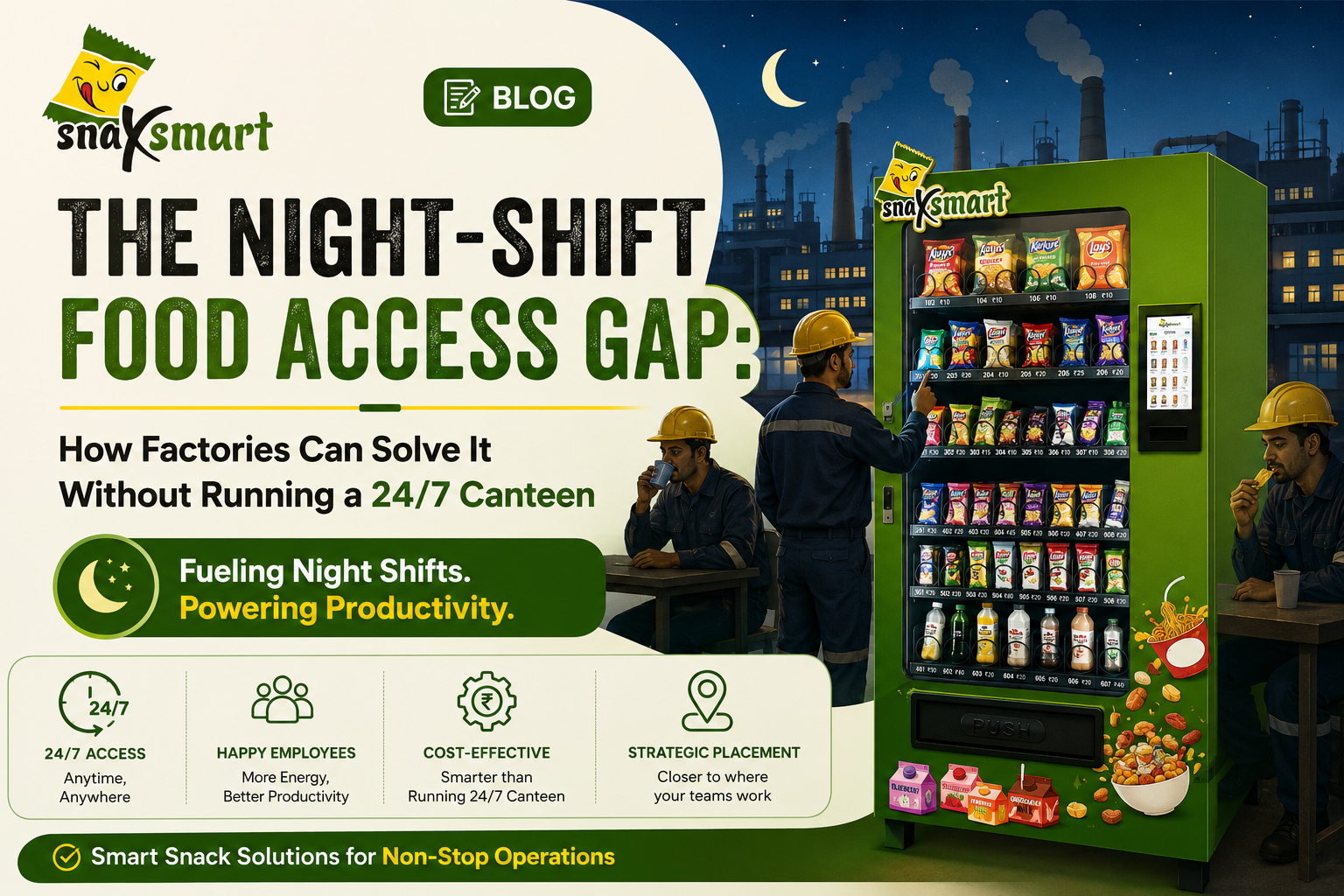
Night-Shift Food Access Gap: How Factories Can Solve It Without Running a 24/7 Canteen
The Night Shift Has a Food Access Problem
At 2 PM, getting something to eat inside a manufacturing facility may be simple. The canteen is operational, pantry staff are available, and nearby food outlets may still be open. At 2 AM, the situation can look completely different.
Production may still be running. Maintenance teams may be working. Security personnel, machine operators, supervisors, warehouse employees and other essential teams may all be on-site. But the food infrastructure available during the day often isn’t operating at the same level.
This creates a night-shift food access gap. Factories could address the issue by keeping their canteen running around the clock, but that introduces additional staffing, operating and management requirements. For many facilities, the better question is:
How can we give employees reliable access to refreshments after regular canteen hours without operating a full 24/7 food service?
This is where snack vending machines for factories can become part of the facility’s food-access strategy.
Why Night-Shift Food Access Is Different
Night-shift requirements shouldn’t simply be treated as a smaller version of daytime requirements.
During regular hours, employees may have access to multiple options: a canteen, cafeteria, pantry, nearby shops or food delivery.
Late at night, those options become much more limited.
A worker who wants a quick snack or beverage may have to wait until the next scheduled meal break, leave the facility, depend on food brought from home, or settle for whatever happens to be available.
For manufacturing plants operating continuously or across multiple shifts, this is not just a pantry issue. It becomes part of the overall employee experience and facility planning.
The challenge gets bigger in large facilities
Consider a manufacturing plant with:
- Multiple production blocks
- Hundreds of employees
- Three rotating shifts
- Warehouses located away from the main canteen
- Maintenance teams working irregular hours
- Security staff stationed at different access points
A single centralized canteen may work well during peak hours but may not be the most practical solution for every employee, location and shift.
Why Simply Running the Canteen 24/7 May Not Be Practical
Keeping a canteen operational overnight sounds like the most straightforward solution. Operationally, however, it can require considerably more than extending the opening hours.
The facility may need additional kitchen employees, service staff, cleaning personnel, supervision, utilities, food preparation and inventory management.
The challenge becomes particularly noticeable when overnight demand is significantly lower than daytime demand.
For example, a factory may have 1,000 people on-site during the day but only 200–300 employees during the night shift. Maintaining the same food-service infrastructure for both periods may not always be efficient.
This creates an opportunity for a hybrid food-access model.
The canteen continues serving employees during its regular high-demand periods, while vending machines provide access during late-night, early-morning and other low-service windows.
How Snack Vending Machines Can Close the Night-Shift Gap
Modern vending isn’t limited to putting a machine near reception and filling it with a few packaged snacks.
For industrial workplaces, vending can be planned around employee count, shift patterns, machine location, consumption behaviour and replenishment requirements.
Here’s how that changes night-shift food access.
1. Provide 24/7 Access Without 24/7 Counter Staffing
The most immediate advantage of 24/7 snack vending machines is availability.
Once installed in an accessible location, employees can purchase available products outside normal canteen operating hours without requiring a person to continuously manage a food counter.
This is particularly useful during:
- Night shifts
- Early-morning shifts
- Weekend operations
- Overtime
- Maintenance shutdowns
- Public holidays
- Irregular production schedules
The objective isn’t necessarily to replace the factory canteen. It is to extend food availability beyond the canteen’s operating window.
2. Place Food Access Closer to Where Employees Work
In a large factory, distance matters.
If the main canteen is several minutes away from a production block or warehouse, employees may spend a significant portion of a short break simply walking there and back.
Instead of depending entirely on one central food point, factory vending machines can create smaller distributed access points.
Potential locations include production-area break zones, warehouses, employee rest areas, administrative blocks, security areas and common spaces.
This creates a more decentralized model:
Central canteen → primary meal service
Vending machines → distributed, anytime snack access
That distinction is important.
3. Support Short and Unscheduled Breaks
Factory employees don’t always take breaks at exactly the same time.
Production schedules, maintenance work and operational responsibilities can create staggered break periods.
A vending machine allows employees to access refreshments when their actual break occurs rather than depending entirely on fixed food-service timings.
For night-shift workers in particular, that flexibility can make workplace food access considerably more practical.
4. Offer More Than the Traditional Chips-and-Cola Machine
The effectiveness of a vending program depends heavily on what is stocked inside the machine.
A machine filled with products employees rarely want will provide limited value regardless of how advanced the technology is.
The product mix can instead be planned around actual workplace demand, with options such as packaged snacks, beverages and other suitable ready-to-consume products.
Different shifts may also demonstrate different buying behaviour.
For example, the preferences of employees purchasing something at 11 PM may not necessarily match those of employees using the machine at 11 AM.
This is where usage data becomes valuable.
Smart Vending Turns the Machine Into an Operational System
The bigger opportunity isn’t simply installing a vending machine.
It’s managing vending intelligently.
Modern smart vending solutions can help operators understand machine-level activity and make better replenishment decisions.
Rather than treating every machine identically, usage patterns can help identify which locations have stronger demand and which products move faster.
This can help answer questions such as:
Which machine receives the most usage?
Which products are selling faster?
When does replenishment need to happen?
Are certain products consistently underperforming?
Does night-shift consumption differ from daytime consumption?
These insights can support more informed inventory planning and reduce dependence on purely manual assumptions.
A Practical Factory Scenario
Consider a plant operating three shifts:
Shift 1: 6 AM–2 PM
Shift 2: 2 PM–10 PM
Shift 3: 10 PM–6 AM
The canteen operates from 6 AM to 10 PM.
Traditionally, management has two choices: extend the canteen throughout the night or leave Shift 3 with limited options.
A vending-based model introduces a third possibility.
The canteen continues serving the two high-volume shifts. Strategically positioned vending machines remain accessible during Shift 3.
Instead of maintaining the entire canteen infrastructure overnight, the factory creates an additional self-service food-access layer.
This can be especially relevant for factories where night-shift headcount doesn’t justify running the full canteen continuously.
Don’t Just Install One Machine at the Entrance
One common mistake is treating vending deployment as a hardware decision rather than a facility-planning decision.
For a large manufacturing plant, the key question isn’t:
“Where can we fit a vending machine?”
It should be:
“Where does the food-access gap actually occur?”
Before installation, facilities teams should assess employee strength by shift, canteen operating hours, break schedules, employee movement, high-traffic areas, distance from existing food facilities and expected demand.
A 100-person facility and a 2,000-person manufacturing campus shouldn’t have identical vending strategies.
Canteen vs Vending Machine Isn’t the Right Comparison
Factories don’t necessarily have to choose one or the other.
Each serves a different purpose.
|
Canteen |
Smart Vending |
|
Suitable for full meals |
Suitable for quick-access refreshments |
|
Best during high-demand periods |
Can remain available 24/7 |
|
Requires operational staffing |
Self-service access |
|
Usually centralized |
Can be distributed across the facility |
|
Works around service timings |
Supports flexible access |
For many facilities, therefore, the stronger model may be:
Canteen + Smart Vending
The canteen remains the core food-service infrastructure, while vending fills the availability gaps around it.
What Should Facility Managers Evaluate Before Deployment?
Before implementing vending machines for manufacturing plants, the decision shouldn’t be based only on machine specifications or rental price.
Facility and procurement teams should consider:
- How many employees work on each shift?
- When is the existing canteen unavailable?
- Which departments are farthest from existing food facilities?
- What types of products are appropriate for employees?
- How frequently will machines require replenishment?
- How will usage and stock levels be monitored?
- Should machines be introduced at one location first before expanding?
A pilot approach can be particularly useful. Start with a high-demand night-shift location, observe usage and then make expansion decisions based on actual demand.
From Employee Amenity to Workplace Infrastructure
A snack vending machine can easily be viewed as a small employee perk.
In a 24/7 factory environment, however, its role can be broader.
It can become part of the infrastructure that helps bridge the gap between when employees are working and when traditional food services are available.
That makes vending relevant not only to employee engagement teams but also to:
- Facility managers
- Administration teams
- HR teams
- Procurement teams
- Plant operations teams
The conversation shifts from “Should we install a vending machine?” to “How should we design food access across every shift?”
That’s a much more useful question.
Closing the Night-Shift Food Access Gap with Snaxsmart
Factories don’t necessarily need to operate a full canteen around the clock just to provide employees with access to snacks and refreshments outside regular service hours.
A strategically planned vending setup can complement existing food facilities and create accessible snack points across shifts and locations.
Snaxsmart provides snack vending solutions for workplaces and industrial environments. For factories evaluating night-shift food accessibility, the starting point should be understanding employee strength, shift timings, existing canteen availability and the locations where access gaps occur.
Planning vending access for a manufacturing facility? Talk to Snaxsmart about a vending setup based on your workforce, shift structure and facility requirements.
Frequently Asked Questions
1. Can snack vending machines operate during night shifts?
Yes. Vending machines can remain accessible outside normal canteen operating hours, making them suitable for workplaces with night shifts and extended operations.
2. Can vending machines replace a factory canteen?
They don’t necessarily need to. For many manufacturing facilities, vending works better as a complementary solution that provides quick snack access when the canteen is closed or inconvenient to reach.
3. Where should vending machines be installed inside a factory?
Placement should be based on employee movement and accessibility. Break areas, warehouses, common areas and locations away from the main canteen may be considered depending on the facility layout.
4. How many vending machines does a factory need?
There isn’t one standard number. Employee strength, number of shifts, facility size, break patterns, machine capacity and expected usage should all be considered.
5. Are snack vending machines suitable for factories with multiple shifts?
Yes. Multi-shift environments are particularly relevant because vending can help provide access across different working hours without requiring every food-service point to operate continuously.
