
Why IT Employees Avoid Office Cafeterias During Peak Hours
Walk into almost any large IT office between 1 PM and 2 PM, and the scene looks familiar.
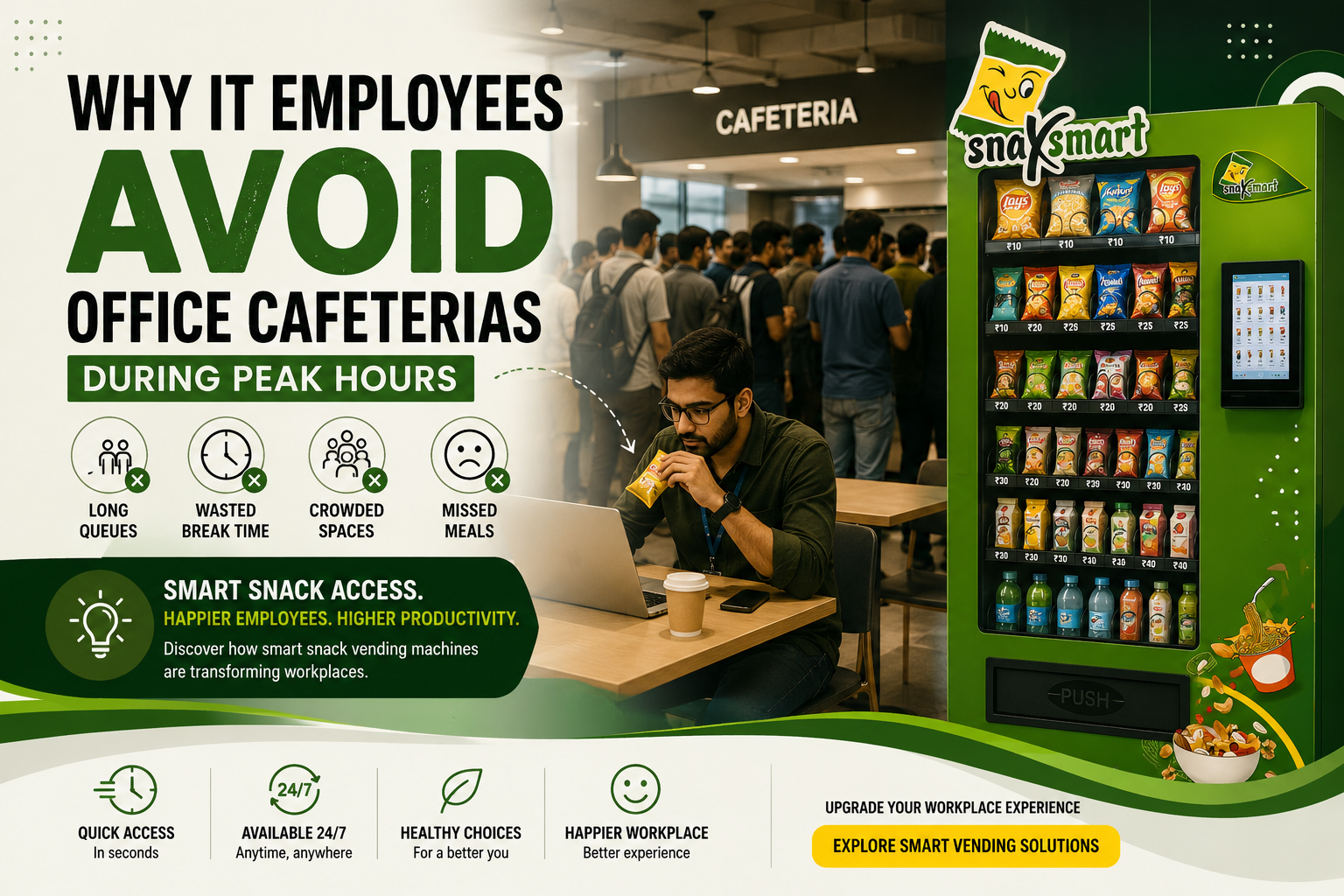
Long queues. Overcrowded seating. Employees checking the time every few minutes. People skipping meals because the wait feels longer than the break itself.
For many employees, lunch breaks are no longer relaxing. They have become rushed, frustrating, and inconvenient.
Ironically, companies spend heavily on office infrastructure, employee engagement programs, and workplace wellness initiatives — yet one of the most common daily pain points still goes unnoticed:
Food accessibility during working hours.
And in fast-paced IT environments where deadlines, meetings, and productivity pressures dominate the day, employees increasingly prefer avoiding crowded office cafeterias altogether.
This shift is pushing companies to rethink how workplace food and snack access should actually work in modern offices.
The Modern IT Workplace Has Changed Faster Than Cafeterias
The way employees work today is very different from five years ago. Hybrid schedules, flexible work hours, continuous meetings, and high-performance expectations have completely changed employee behavior inside offices. But most office cafeterias still operate using an outdated system designed for fixed lunch timings and predictable employee movement. That no longer reflects reality.
Today’s IT employee may:
- Join back-to-back client calls
- Work across global time zones
- Take shorter breaks
- Skip traditional lunch hours
- Prefer quick snack-based eating patterns
- Need food access beyond cafeteria timings
Yet the typical cafeteria setup creates friction instead of convenience.
Why Employees Avoid Office Cafeterias During Peak Hours
1. Long Queues Waste Valuable Break Time
One of the biggest frustrations employees face is simply waiting.
In many IT parks and corporate campuses, employees spend:
- 10–20 minutes standing in queues
- Additional time searching for seating
- More waiting for billing and food pickup
For someone with only a 30-minute break window, that becomes exhausting. Instead of feeling refreshed, employees return stressed and rushed.
Over time, many employees start:
- Skipping meals
- Ordering unhealthy fast food
- Eating at desks
- Delaying meals entirely
This directly impacts focus, energy levels, and productivity.
2. Peak Hour Crowding Creates Workplace Fatigue
Crowded cafeterias are mentally draining.
Noise, overcrowding, lack of seating, and long movement lines create unnecessary workplace fatigue during what should ideally be a recovery break.
Employees often avoid cafeterias because they simply want:
- Faster access
- Privacy
- Convenience
- Minimal interruption
This is especially common among:
- Developers
- Night-shift employees
- Operations teams
- Support teams
- Employees handling global clients
Many employees would rather grab a quick healthy snack nearby than navigate a crowded cafeteria environment.
3. Cafeterias Don’t Match Flexible Work Patterns
Modern workplaces no longer operate on one fixed lunch hour.
Employees now work:
- Early morning shifts
- Late evening schedules
- Night operations
- Rotational timings
Traditional cafeterias often fail to support these changing schedules.
For example:
An employee working on a US client escalation at 4:30 PM may not have time for a cafeteria visit. By the time they get free, food counters may already be closed or crowded again.
This creates a major accessibility gap inside offices.
The Hidden Business Impact Most Companies Ignore
Many companies underestimate how workplace food accessibility affects overall employee experience.
But small daily frustrations compound over time.
Common Workplace Problems Linked to Poor Food Accessibility
|
Workplace Issue |
Employee Impact |
|
Long cafeteria queues |
Reduced break quality |
|
Limited food access |
Skipped meals |
|
Overcrowded spaces |
Mental fatigue |
|
Inconvenient timings |
Reduced productivity |
|
Unhealthy snack dependency |
Energy crashes |
|
Delayed breaks |
Lower employee satisfaction |
When employees repeatedly struggle with something as basic as food access, it quietly affects:
- Workplace satisfaction
- Employee morale
- Productivity
- Focus levels
- Workplace convenience perception
And in competitive IT environments, employee experience matters more than ever.
The Rise of Smart Workplace Food Solutions
Modern offices are now shifting toward smarter workplace convenience systems.
Instead of depending entirely on large cafeterias, many organizations are introducing:
- Smart snack vending machines
- Self-service food access points
- Cashless snack stations
- Healthy snack vending solutions
- Micro convenience kiosks
These systems are designed around how employees actually behave today.
Not how offices operated ten years ago.
Why Smart Snack Vending Machines Work Better in IT Offices
A smart snack vending machine solves multiple workplace pain points instantly.
Faster Access
Employees can grab snacks or beverages within seconds instead of waiting in long cafeteria queues.
This is especially useful during:
- Short breaks
- Overtime hours
- Evening shifts
- Meeting-heavy schedules
Better Employee Convenience
Employees increasingly value convenience over formality.
A quick snack station inside the office floor feels:
- Faster
- Easier
- More accessible
- Less disruptive
That small convenience significantly improves workplace experience.
Supports Flexible Work Hours
Unlike cafeterias with limited timings, vending machines support employees throughout the day.
This becomes extremely valuable for:
- 24/7 operations
- IT support teams
- Night shifts
- Hybrid work environments
Encourages Healthier Snacking
When healthy snacks are easily accessible, employees make better food choices.
Instead of:
- Sugary snacks
- Outside junk food
- Skipping meals
Employees can access:
- Protein bars
- Healthy chips
- Nuts
- Low-sugar beverages
- Functional drinks
This supports workplace wellness initiatives naturally.
Real Workplace Scenario Most IT Companies Relate To
Imagine this:
An employee has back-to-back meetings from 12 PM to 3 PM.
They finally get a 10-minute gap.
The cafeteria downstairs is overcrowded.
Waiting alone takes 15 minutes.
Instead, they grab:
- A healthy snack
- A beverage
- A quick energy boost
From a nearby smart snack vending machine within seconds.
No queue.
No disruption.
No wasted break time.
That single convenience changes the employee experience completely.
Why HR and Facility Teams Are Rethinking Workplace Food Access
Today, HR teams are focusing heavily on:
- Employee wellness
- Workplace satisfaction
- Retention
- Employee experience
- Convenience-driven infrastructure
And facility managers are under pressure to:
- Improve workplace efficiency
- Reduce employee complaints
- Optimize office operations
- Support hybrid workplace models
This is why workplace snacking is no longer just a cafeteria discussion.
It is becoming part of workplace infrastructure strategy.
Smart Snack Vending Machines vs Traditional Cafeterias
|
Factor |
Traditional Cafeteria |
Smart Snack Vending Machine |
|
Waiting Time |
High |
Minimal |
|
Accessibility |
Limited timings |
24/7 availability |
|
Employee Convenience |
Moderate |
High |
|
Operational Dependency |
High manpower |
Automated |
|
Scalability |
Complex |
Easy |
|
Healthy Snack Access |
Limited |
Flexible |
|
Space Requirement |
Large |
Compact |
|
Queue Management |
Difficult |
Faster access |
How Snaxsmart Helps Modern Offices Improve Workplace Convenience
Snaxsmart helps companies create smarter workplace snack experiences through:
- Smart snack vending machines
- Healthy snack access
- Cashless payment systems
- Office-friendly vending infrastructure
- Employee-focused convenience solutions
For IT companies, this means:
- Reduced cafeteria pressure
- Faster snack accessibility
- Better employee convenience
- Improved workplace experience
- Support for flexible work environments
Without requiring major operational changes.
Signs Your Office Needs a Better Workplace Snack Solution
If employees frequently:
- Skip meals
- Complain about cafeteria queues
- Order outside junk food
- Leave campus for snacks
- Miss breaks due to meetings
- Work overtime regularly
Then your office likely has a workplace accessibility problem — not just a cafeteria problem.
The Future of Workplace Convenience Is Self-Service
Modern workplaces are moving toward:
- Automation
- Employee convenience
- Flexible infrastructure
- Smart accessibility
The companies creating better employee experiences are the ones solving small daily frustrations before they become larger workplace dissatisfaction issues.
And food accessibility is one of the easiest improvements companies can make.
Still relying only on crowded office cafeterias?
Give your employees faster, smarter, and healthier snack access with Snaxsmart’s smart vending machine solutions designed for modern workplaces.
Book a free consultation today and transform workplace convenience.
Frequently Asked Questions
Why do employees avoid office cafeterias during peak hours?
Most employees avoid cafeterias because of long queues, overcrowding, limited break time, and inconvenience during busy working hours.
What is the best alternative to office cafeterias?
Smart snack vending machines are becoming a popular alternative because they provide faster, self-service snack access inside offices.
How do snack vending machines improve employee productivity?
Employees save time, avoid long queues, access snacks quickly, and maintain better energy levels during work hours.
Are smart vending machines suitable for IT companies?
Yes. Smart vending machines are highly suitable for IT offices because they support flexible work schedules, overtime operations, and employee convenience.
What snacks can be offered in office vending machines?
Healthy snacks, protein bars, beverages, nuts, chips, energy drinks, low-sugar snacks, and more can be included based on workplace preferences.
